


Author: Aleksei Sergeev. Translated into English and adapted by the author; Russian wordplay is recreated where possible or briefly glossed where necessary. Originally published in Russian by Parni+ on 19 March 2026.
Russian queer history of the 2010s has many dark symbols: the federal “propaganda” law, bans on public actions and violent arrests, television hysteria, politicians, priests and other public figures producing hatred in the name of “traditional values”, homophobic attacks, torture and murder.
But there were other symbols too — inspiring and joyful ones: the May Day Rainbow Column in St Petersburg, the release of multicoloured balloons during the Rainbow Flash Mob, and Bobik, the endearing mascot of a queer film festival. Among them was the aptly named, sometimes caustic satirical anti-award the Golden Enema (Zolotaya Klizma), founded by the Alliance of Heterosexuals and LGBT for Equality. Its organisers called it the “Russian Social and Hygienic Anti-Award” and presented it to the “Homophobes of the Year” in fields ranging from politics and journalism to culture — people who had particularly distinguished themselves through public homophobia and transphobia.

Photo: A “nurse” with the Golden Enema trophy at the first award ceremony, Rosbalt News Agency, Saint Petersburg, 12 December 2012.
The first ceremony took place in December 2012 at the press centre of the Rosbalt news agency in St Petersburg and triggered a wave of press coverage and television reports. The anti-award did more than publicly ridicule homophobes. More importantly, it redirected attention towards the source of hatred. In a country where LGBT people were being portrayed as the main “problem”, demonised and, at best, made the butt of homophobic jokes, the objects of satire were no longer queer people but those producing hatred, moral panic and political violence.
At the inaugural ceremony, homophobia was explicitly described as a social illness: “Our society is sick. And this illness is called homophobia.” The inversion was deliberate and precise: the language of pathologisation traditionally directed at LGBT people was energetically turned back against homophobia itself and those who promoted it. The metaphor existed not only in the presenters’ scripts but visually as well: gilded enemas prescribed to the winners as a “treatment” were carried onto the stage by a “nurse” wearing a white coat and cap. Afterwards, anyone who wished could pose for photographs with the nurse and the “awards”.
Satire as a Political Language
The award quickly developed a vocabulary of its own, and this was one of the things that made the anti-award so vivid and memorable. The names of its categories were aphoristic and frequently based on wordplay: “Wisdom Itch” — a Russian pun on “wisdom tooth” — for figures in science; “Jellied Tongue”, simultaneously the name of a dish and a reference to a loose or mendacious tongue, for the media; “Cult-Urn”, playing on the Russian word for “culture”, for cultural figures; and “Regi@nal Stimulation” for local officials. This was an important activist move: the anti-award did not simply document homophobia; it created its own counter-language — witty, vicious and highly shareable.
“I remember how the idea for the anti-award was born. After an Alliance meeting, we were sitting in a café discussing what was happening in the country — not all of it cheerful — and trying to joke about it. Then suddenly the image of the Golden Enema appeared. At first it was just a joke, but very soon the table came alive and a creative process began to spark. There was no stopping that energy. We started throwing out names of candidates and inventing categories — almost a game of verbal wit. Some appeared easily, almost at once; others came later, after weaker versions had been crossed out again and again. It was a collective effort: someone created the visual identity of the award, others polished the scripts, worked on props, found people and negotiated with venues,” recalls Aleksei Sergeev, co-organiser of the anti-award, activist and co-founder of the Club of Creative Activism.
The humour sometimes operated close to the edge, drawing on a Rabelaisian tradition of bodily and physiological satire. For example, the category “Holy Simplicity” for religious figures was pronounced by the presenter in Russian so that an attentive listener could hear the word “prostate”. “Electoral Dysfunction” alluded to erectile dysfunction, while the Grand Prix title “An(n)als of History” slid from elevated historical language into the bodily realm — precisely the kind of carnival humour that suited the “award”.
This provocative tone was established at the very first ceremony. In 2012, television propagandist Dmitry Kiselyov won the “Jellied Tongue” category “for truly Nordic homophobic fury” after calling for the hearts of gay men to be “burned and buried”. Children’s ombudsman Pavel Astakhov, who supported a ban on the adoption of Russian orphans by countries recognising same-sex marriage, received the “Kuzka’s Mother” award — named after a Russian idiom of threat — “for exploiting children in the struggle against human rights”.
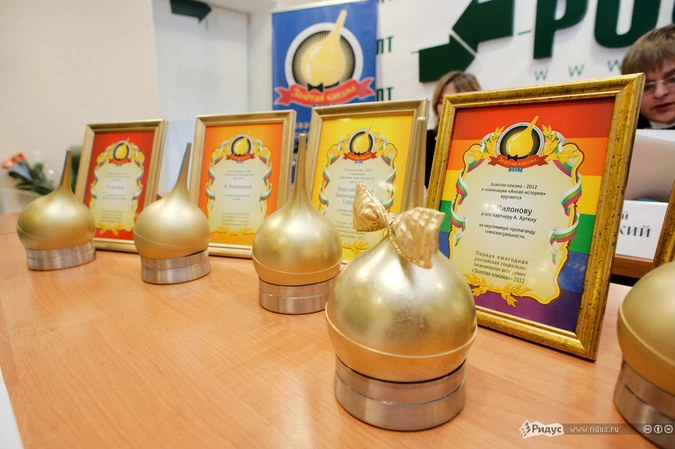
In the parliamentary category “Electoral Dysfunction”, the award went to Elena Mizulina, author of homophobic legislation, “for defending federal morality by perverse means”. A collective award, “The Morality Organ”, went to an entire government body — the Legislative Assembly of Novosibirsk Region — “for its contribution to separating Russia from Europe”. The title also alluded to Organchik, the mechanical organ in the head of a mayor in Saltykov-Shchedrin’s satirical novel, capable of producing only two phrases: “I’ll ruin you!” and “I won’t tolerate it!”
The Grand Prix, “An(n)als of History”, went to Mizulina’s regional counterpart in St Petersburg, Vitaly Milonov, and his “partner”, parliamentary aide Anatoly Artyukh, “for tireless propaganda of homosexuality”. The wording was particularly caustic: the Alliance inverted one of the central clichés of the period, suggesting that it was homophobes rather than queer people who had made LGBT issues an obsessive feature of public debate.
One year later, after the federal law banning “LGBT propaganda” had been adopted, the language and visual imagery of the anti-award became even harsher. In 2013, Arkady Mamontov, who had linked the fall of a meteorite to the existence of LGBT people, received an award in the “Goebbels School of Journalism” category “for a caveman case of cerebral meteorism” — a pun linking “meteorite” to “meteorism”, a medical term for intestinal gas. Pole vaulter Yelena Isinbayeva, who claimed that same-sex relationships were traditionally alien to Russia, won in the “Olympic Village” category “for a virtuoso leap into a puddle” — a Russian expression for making a spectacular blunder. Actor Ivan Okhlobystin, who had suggested “burning gays in ovens”, received the award in the category “Creators with a Regime”, “for serving the demon of Nazism under the mask of spirituality”.
The Russian Foreign Ministry won the “Homophobe by Profession” category “for boundless/borderless disgrace”. The St Petersburg Committee for Law, Order and Security received the special local award “Hysteria of a Town” — a pun on Saltykov-Shchedrin’s satirical novel The History of a Town — “for lawlessness within the law”. The committee routinely produced refusals banning opposition and LGBT human rights actions in the city.

In the public vote held through the Alliance’s social media page, the Grand Prix — the “Tsar Enema” — went to Vladimir Putin, who had signed the homophobic law. The prize took the form of an enormous ornate enema topped with a carving in the shape of the Cap of Monomakh and trimmed with fur — a sacred symbol of Russian sovereign power. Patriarch Kirill also received an “award” in the “Pop Business” category (in Russian, pop also means “priest”) “for apocalyptic hysteria”, following homophobic statements including his claim that same-sex marriage was “a symptom of the Apocalypse”. Mindful of the recipient’s reputation for luxury, his enema was additionally decorated with imitation gemstones.
The following year, the anti-award introduced an international category, “Shame Without Borders”. Homophobic preachers Scott Lively and James David Manning were honoured “for homophobic pollution of the planet”. Singer Valeria received the prize in the “Music Convoy” category “for perfect harmony with the ruling regime”. By then, however, the organisers were beginning to feel a certain fatigue: in the “Severe Case” category for repeat homophobes, Vitaly Milonov won yet again.
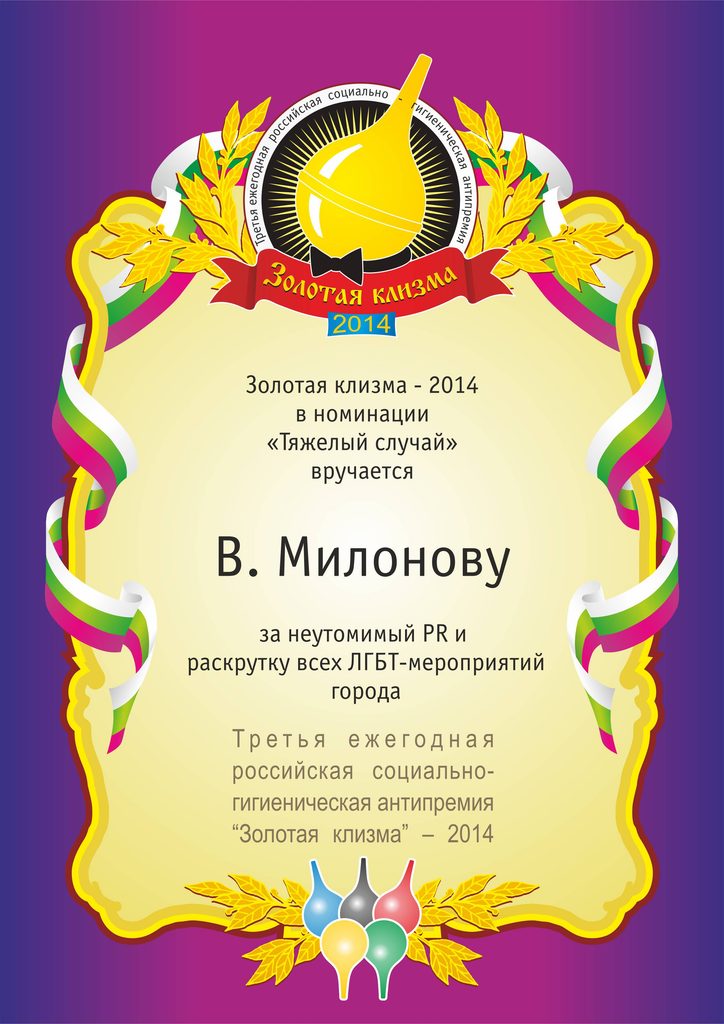
Vitaly Milonov’s certificate for the 2014 “Severe Case” category.
Carnival Against Pathos
Attention to the Golden Enema was attracted not only by its humour and caustic descriptions of the winners but also by its theatrical award ceremonies, featuring a “nurse”, a “doctor”, or even an entire medical “consultation panel”. “Treatment” was prescribed in the form of gilded enemas, which gradually became more ceremonial: the minimalist stainless-steel IKEA soap dishes used as bases at the first ceremony gave way to stands decorated with imitation marble and “gold”. At first, the awards and certificates were sent to the winners by post; later, this practice was abandoned and the organisers limited themselves to publicly announcing their names. The buffoonery was not decoration. It was part of the concept.
“From the perspective of activism theory, the Golden Enema was an example of tactical frivolity — a tactic based on play, absurdity and comic action. Instead of arguing with homophobic rhetoric on its own official and moralising terms, activists moved the conflict into the realm of satire and grotesque, where they became the ones setting the rules. The pathos of homophobic politics — its language about protecting children, morality and the sacred foundations of the state — became material for jokes and farce. This move deprived public homophobes not only of their habitual seriousness but also of symbolic authority, while giving the LGBT community back a sense of agency and the possibility of speaking without having to defend or justify itself,” says Aleksei Sergeev.
How Satire Became a Form of Resistance
Looking more closely at the mechanics of the Golden Enema, it operated on several levels at once.
First, there was satirical inversion. Those who loudly spoke of “perversion” and “illness” themselves became the objects of public scrutiny, ridicule and a sanitary procedure. The medical theme was visually reinforced by the enema as an instrument of cleansing. Simple and instantly recognisable, it worked effectively as the central symbol. The language used — describing homophobia in terms of “intoxication”, “waste” and “toxins” — shows that the image was conceived as a political metaphor rather than merely as the coarse joke it could easily appear to be.
The activists also drew on the principles of culture jamming: a form of social protest that disrupts, parodies or reinterprets dominant media culture, familiar institutions, cultural forms and symbols. The anti-award appropriated the official structure of an awards ceremony — prizes, nominations, winners, ceremonial presentation — and turned it inside out. The game depended on contrast. It was no coincidence that the first presenters looked entirely respectable: human rights defender and university lecturer Dmitry Dubrovsky, for example, wore a black tuxedo and bow tie while delivering a satirical script with a perfectly serious expression.
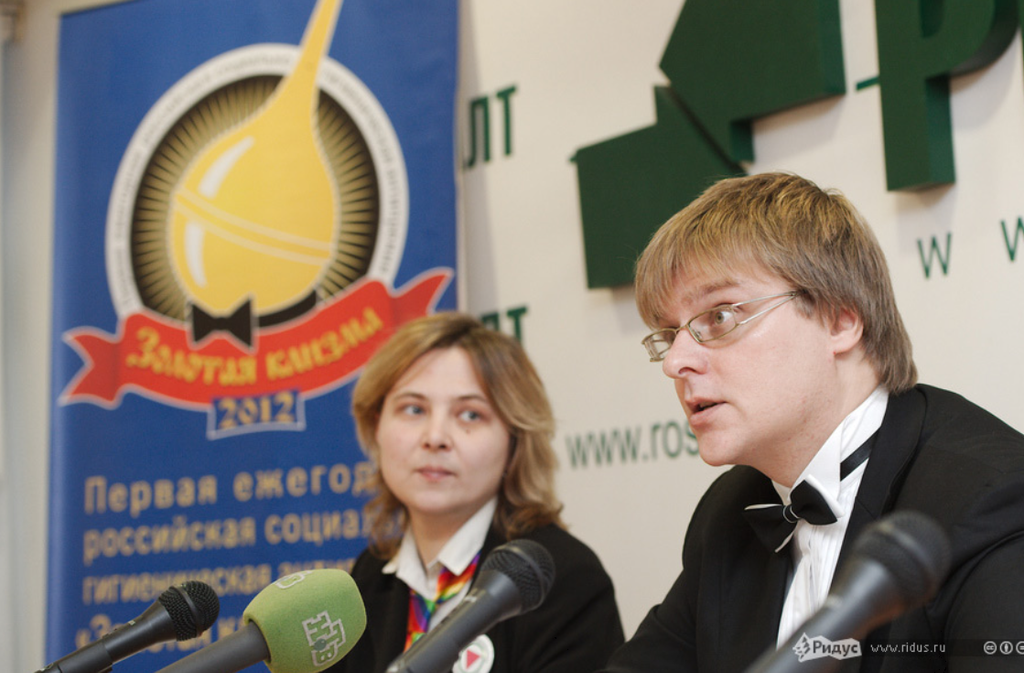
Second, the anti-award format was extremely well adapted to the media. Aphoristic category titles and barbed jokes about famous recipients easily turned into headlines, while the ceremonies themselves provided colourful visual material. The choice of venues was equally strategic: a news agency press centre, a press club, and the conference hall of the Institute of Regional Press. These locations were convenient for journalists and helped secure extensive coverage; media partners distributed press releases directly to newsrooms.
Finally, the Golden Enema became a way of mapping homophobia as a system. Every year, the anti-award tracked and brought together federal politicians and local officials, religious figures, journalists, cultural workers, scientists and athletes, and later representatives of business. Under the anti-award’s magnifying glass, it gradually became clear that these were no longer isolated “harsh statements” or “local excesses”, but the construction of an entire infrastructure of state discrimination and homophobia.
This became especially visible in the later ceremonies, when proper names turned into generic categories: “Ward No. 6, Mizulina Memorial”, “The Milonov Anti-Award”. The “Orwell Ministry of Truth” category, awarded “for regularly generating LGBT ‘Two Minutes Hate’ on air”, could apply to virtually any state media outlet. Federal and regional children’s ombudsmen repeatedly appeared among the nominees, giving rise to the category “Children in Cages”. By the third ceremony there was already a category called “Systemic Bastardry” — a Russian pun on “systemic lupus” — awarded to the Office of the Presidential Commissioner for Children’s Rights.
As the illness spread to other institutions, “Mummy’s Little MP” was joined by a category for judges, “Production of Absurdity” — a Russian pun that turns the word for “judicial proceedings” into “the production of absurdity”. Categories such as “Money Smells” and “Straight Husbandry” appeared for business, while “Spiritual Stapler” covered religious figures of every kind. The proliferation itself demonstrated how hatred was being reproduced by an increasingly wide range of public actors.
A Diagnosis of an Era
Over five years, the tone of the Golden Enema changed noticeably. If the early anti-awards were primarily satirical responses to the actions and statements of particular notorious figures, the anniversary ceremony amounted to a diagnosis of the era itself. In December 2017, the Alliance belatedly celebrated its fifth anniversary at the Malevich club in St Petersburg. The evening opened with the anniversary Golden Enema. The winners were chosen through an online vote, so the selection could quite literally be called the “voice of the queer people”.
Journalist Maxim Shevchenko won in the category “Full Paragraph” — a Russian euphemism for “total fucking disaster” — while priest Dmitry Smirnov, who for years had promoted HIV denial — with a child in one follower’s family ultimately dying without treatment — won “Spiritual Stapler” — a pun on the Russian political cliché “spiritual bonds”. Obscurantist businessman German Sterligov, whose overpriced farm shops displayed signs reading “Sodomites Not Allowed”, received the Golden Enema in the “Straight Husbandry” category, with a formulation built around the coined Russian word “PR-astiya”, blending “PR” with a homophobic slur and turning the insult back on someone using LGBT issues for self-promotion.
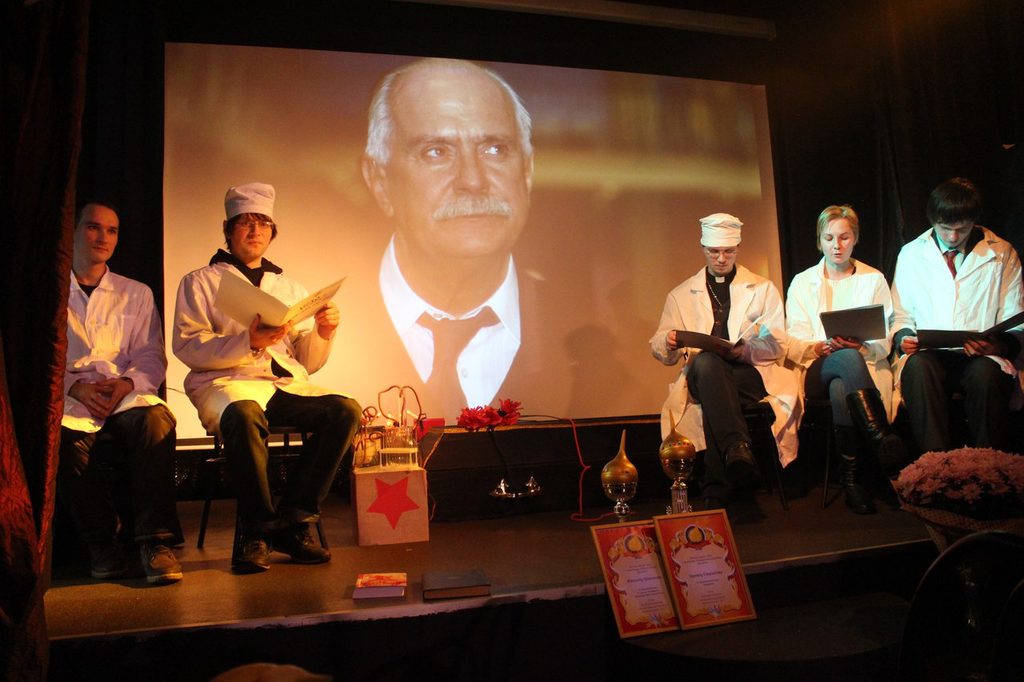
Film director Nikita Mikhalkov, outraged by images of Nureyev’s genitals in Bolshoi Theatre scenery and by colleagues in the West allegedly being “cancelled” for not making films about LGBT people, won “Star Disease” for “multi-storey geni(t)ality”. Chechen ombudswoman Kheda Saratova, who denied the persecution of gay men in the republic, won “Regi@nal Stimulation” for a Russian pun combining legal incompetence and unfitness, beating the speaker of the St Petersburg Legislative Assembly, Vyacheslav Makarov, who had invented the phrase “LGBT special forces”. Makarov — a self-styled “warrior of Christ” — nevertheless did not go without a prize: he received a personal enema in the category “Mariinsky Trench” — a play on the Mariana Trench and the Mariinsky Palace, symbolising the depths to which “sovereign” parliamentarianism had fallen.
Homophobic activist Timur Bulatov, who had caused considerable harm to LGBT people and queer activists before himself ending up in pre-trial detention, received the personal “Golden Prison Toilet” prize. Finally, Vitaly Milonov, by then promoted from the St Petersburg parliament to the State Duma, won “The Snarl of Federalism” “for chronic services, together with the lifetime title of Enema-Bearer honoris causa”. The organisers also decided to add Milonov’s name to the title of the anti-award itself and, since he had already won three times, to stop presenting him with further enemas: medicine was powerless in this case.
This time, however, the scenography mattered more than the list of nominees. The final ceremony took place on 21 December and resembled not simply an awards presentation but a vivid theatrical performance, featuring a medical consultation panel on “the darkest night of the year”. The image was a logical continuation of the original “social and hygienic” metaphor: by 2017, homophobia in Russia looked less and less like a collection of isolated incidents and increasingly like a mainstream phenomenon embedded in government, the media and everyday life.
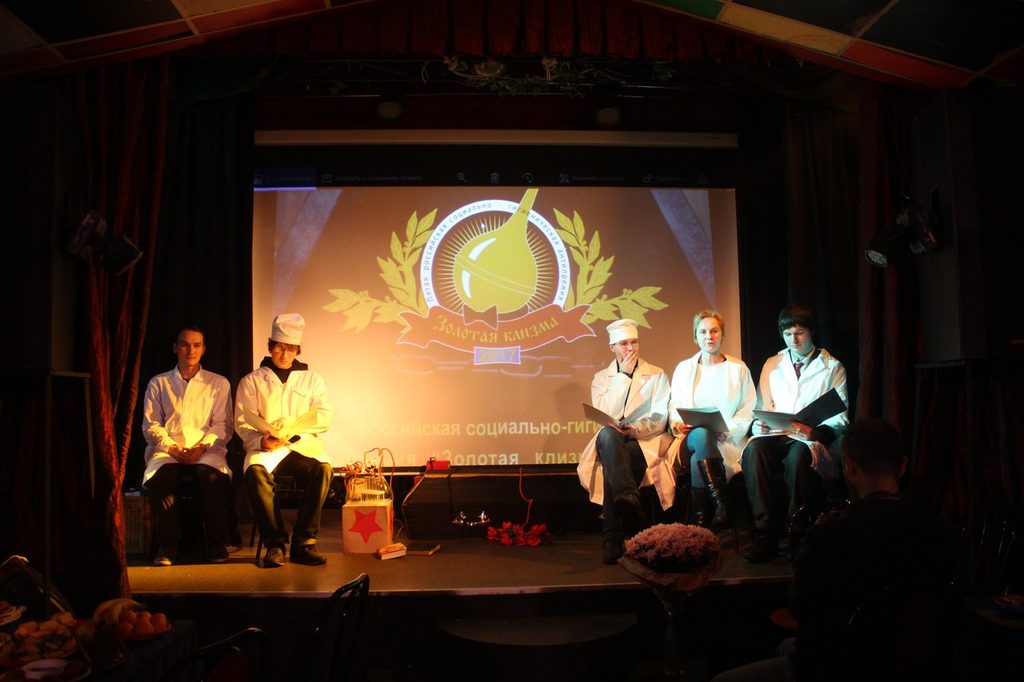
A coffin stood on the stage. According to participants’ recollections, “the fumes of homophobia” escaped from it as an activist hidden inside lifted the lid and operated a smoke machine. The satirical award had transformed into a funeral carnival: the subject was no longer individual cases but an historical tendency.
Another detail is worth noting. In 2017, one of the nominees came to collect his “award” in person. It was Alexander Bronstein, director of the Frog psychological centre, who had won the “Swamp of Ignorance” category for “pseudo-croak-lified assistance to the LGBT community” — a pun on the centre’s name and “qualified assistance”. An employee of the centre’s hotline had rudely refused to work with a client after learning about his sexual orientation, used a homophobic slur, while the director described homosexuality as an illness.
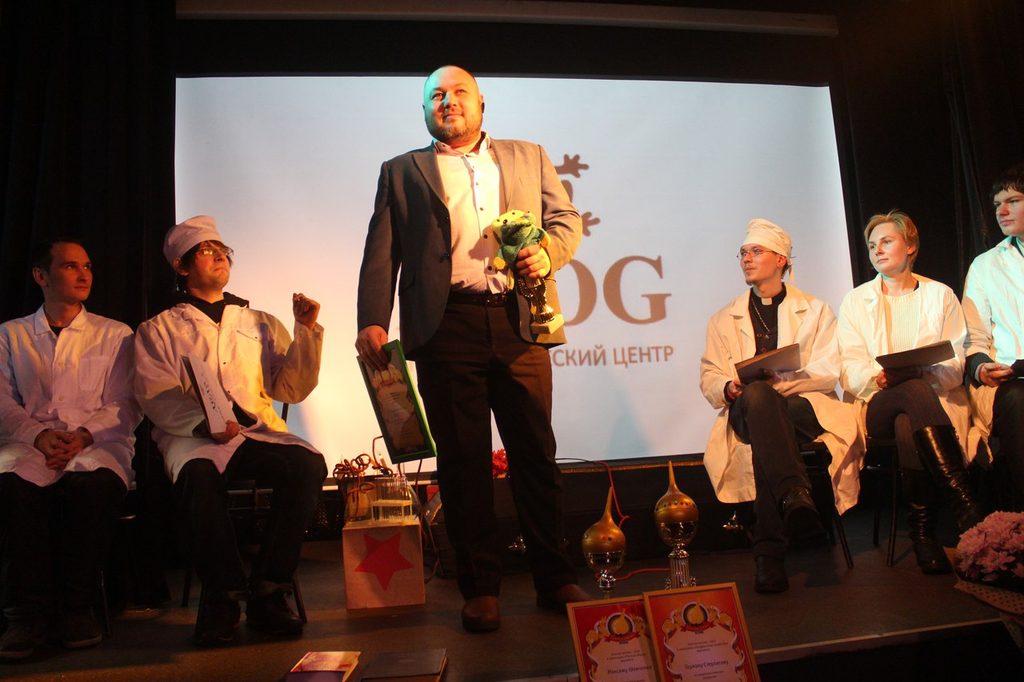
Photo: Alexander Bronstein, director of the Frog psychological centre, collecting his “award” at the final Golden Enema ceremony, 2017
This extended the anti-award beyond its usual targets. The object of satire was no longer only state and media homophobia but also a business belonging to the helping professions while reproducing the language of hatred. The recipient said that staff at the centre had subsequently undergone additional professional training and announced the launch of a hotline for queer people. This offered a measure of hope: a business had recognised the importance of its LGBT audience, entered into dialogue and shown itself capable of change.
From Media Event to Internal Support
Over time, the press wrote less and less about the Golden Enema. There were two reasons. The first was growing censorship: the space for ironic public criticism of homophobia in Russia was visibly narrowing.
“We began noticing the restrictions by the end of 2013, after the second ceremony. Although a lot of journalists attended, the news that Putin had received the main ‘Tsar Enema’ award appeared in only a couple of media outlets. Five publications mentioned the Golden Enema awarded to Patriarch Kirill, while around fifteen covered the award itself and the other nominees. But when it came to an award for the country’s top political figure, journalists suddenly went completely silent. The authorities are extremely sensitive to humour directed at them, and media organisations were afraid of ‘what might happen’,” recalls Aleksei Sergeev.
The third ceremony, which took place after the annexation of Crimea, demonstrated that the anti-award’s media potential had largely been exhausted. Apart from the tightening political screws, there was a second, obvious reason: even the most successful creative format inevitably loses the effect of novelty over time. What had looked like a brilliant satirical discovery in 2012 had become, though still witty, a familiar ritual. As media interest declined, the ceremony moved in 2016 to a club popular with the queer community; one year later, the organisers decided that the anniversary fifth ceremony would also be the last.
This did not mean that the anti-award had lost its meaning. Rather, its function changed. At first it had primarily been a striking media event; later it increasingly became an outlet for the LGBT community itself, a kind of private gesture of defiance. As state homophobia intensified and became normalised, simply being able to gather among one’s own people, speak a shared language, laugh, and express anger and fear became a political practice in itself. As early as spring 2016, during the Equality Week festival, Alliance activist Aleksei Nazarov had incorporated elements of clowning into his role as presenter. The anti-award was becoming an opportunity to laugh as the darkness thickened.
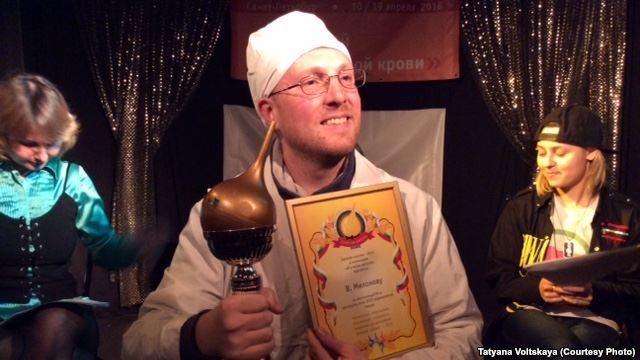
Photo: Alliance activist Aleksei Nazarov improvising in the role of a “doctor” at the 2016 ceremony.
Laughter was no longer merely an accessory to public activism but a means of communal survival. The Golden Enema offered a chance to catch one’s breath and recover a sense of agency, to reverse the usual distribution of power and turn into objects of ridicule those accustomed to speaking in the name of “normality”. This is an important dimension of the anti-award that is easy to miss if it is assessed only in terms of media reach.
Echoes and Continuations
Although the Golden Enema had no direct equivalent, the idea had several international parallels.
In Scotland, Stonewall presented a negative award called Bigot of the Year, while English-language queer media published annual lists of prominent public homophobes, such as The Advocate’s Phobie Awards. Germany had the negative media prize Saure Gurke — “Sour Cucumber” — although it was aimed at sexism in the media rather than homophobia. Against this background, the Golden Enema stands out as a complete activist, artistic and media gesture: not merely a list of nominees but an elaborate satirical ceremony with its own visual language, original vocabulary, multi-year history and mythology.
The tactic of “medical inversion” continues to be used today. In Croatia, activists dressed as doctors presented government ministers with “medical examinations” listing homophobic “symptoms” and prescriptions such as “one tablet of openness before meals”, “two tablespoons of tolerance for diversity” or “an injection against dogma”. In Canada, one campaign humorously represented queerphobia as a collection of irrational fears requiring treatment, while in Ukraine billboards announced that a “cure for… homophobia” had been discovered. A dedicated website allowed users to order boxes of “Friendly Pills” containing a couple of “anti-homophobia tablets”. The accompanying “instructions”, formatted as a diagnostic test, dismantled common misconceptions about LGBT people.
Why This History Matters
Today, when Russian queer public life has largely been forced into exile, underground existence or survival mode, the history of the Golden Enema matters as more than an archival curiosity. It is a reminder that activism is not only routine work but also creative invention: producing something new, crossing imposed boundaries and finding ways to act under conditions of unfreedom.
Sometimes a well-chosen form can do as much for a movement as a public demonstration or a powerful slogan. The Golden Enema was precisely such a form: at once a chronicle of homophobia, a powerful media gesture, a carnivalesque performance and a way of enduring together a period in which homophobia was becoming state policy.
Through provocation and humour, the anti-award touched a nerve of its era. It demonstrated that the Russian LGBT movement was capable not only of speaking about vulnerability and pain, but also of answering hatred through vivid and intelligent political satire.