
Author: Aleksei Sergeev. English translation by the author
Originally published in Russian by Parni+ on 15 March 2026.
Context: the truck drivers’ protests and the “Platon” toll system
In late 2015, mass protests by truck drivers erupted across Russia in response to the introduction of a new road toll collection system known as Platon. Starting on 15 November, the state required drivers of trucks weighing over 12 tons to pay a fee for every kilometer traveled on federal highways. Officially, the collected funds were intended for road repairs, but the system was administered by a specially established private company. The ultimate beneficiary of the scheme turned out to be Igor Rotenberg, the son of billionaire Arkady Rotenberg, a close associate of Vladimir Putin.
Truck drivers reacted with outrage: the additional levy threatened to bankrupt many of them, particularly independent carriers, and to drive up consumer prices nationwide. Protest actions began on 11 November. In around 40 regions, from the Far East to the North Caucasus, hundreds of truck drivers took to the highways, partially blocking traffic by lining up their vehicles along the roadsides. In addition, drivers organized rallies, “go-slow protests” (slow-moving truck convoys), set up protest camps, and even prepared a “march on Moscow” with a large-scale demonstration in the capital if the Platon system was not repealed.
The authorities sought to prevent a unified protest in Moscow. In early December, police blocked trucks from approaching the city, disrupting logistics. Nevertheless, unrest continued: near Saint Petersburg and in the Moscow region, truck drivers established protest headquarters at truck stops and parking areas.
The Kremlin stated that the issue was “not on the presidential administration’s agenda.” At the same time, state propaganda intensified: government-controlled media either ignored the protests or portrayed truck drivers as a “fifth column”—internal enemies allegedly inspired from abroad.
In this environment, truck drivers often lacked public support. Among traditional political forces, only the Communist Party expressed solidarity, with its deputies issuing statements in support. The most unexpected allies of the protesting drivers were LGBT activists from Saint Petersburg. Their involvement became a unique example of cross-movement solidarity between different communities under conditions of growing authoritarianism.
“The Alliance of Heterosexuals and LGBT for Equality”: who they are
Support for the truck drivers was initiated by the Alliance of Heterosexuals and LGBT for Equality, a movement founded in Saint Petersburg. This informal group emerged in the spring of 2012, following the adoption in the city of a controversial law banning so-called “homosexual propaganda.” According to activists, the Alliance’s goal was to unite heterosexual allies and members of the LGBT community in a joint struggle for equal rights and against discrimination and homophobia. The Alliance opposed the false division between heterosexual and LGBT “camps” imposed by propaganda and sought to demonstrate that many heterosexual people oppose the authorities’ homophobic policies.
The movement has remained unregistered and volunteer-based, but within a few years it built a broad support network. By 2015, the Alliance’s social media communities had approximately 23,000 members.
The Alliance’s activities were not limited to LGBT-related issues. A broad agenda was one of the core principles of this ally-founded movement.
“The Alliance is not focused solely on LGBT+ issues. We believe in solidarity, which is why we supported truck drivers, political prisoners, anti-war protests, urban preservation activists, the women’s movement, people with disabilities, and others. We are members of society, and we care about what is happening in the country,”
— stated in the movement’s manifesto.
Indeed, the Alliance regularly joined broader civic actions and became a co-founder and active participant in the coalition of civic, political, and human rights organizations Democratic Petersburg. At the same time, the Alliance organized its own initiatives, ranging from the annual anti-discrimination festival Equality Week to creative street performances, such as the satirical “Milonov’s Aria” composed of insults by a homophobic MP and performed outside the city parliament, or the Rainbow Coffin action commemorating victims of hate crimes.
A creative approach became the Alliance’s hallmark: its original actions attracted media attention and helped communicate the issue of discrimination to a wide audience. It was therefore unsurprising that the Alliance became the initiator of an unconventional campaign in support of the protesting truck drivers.
How LGBT activists supported truck drivers: December 2015
The idea emerged within the movement in late November 2015, as protests against Platon were gaining momentum. In addition to the movement’s core value of solidarity, there was also a pragmatic calculation: major media outlets largely ignored the truck drivers’ protests, while LGBT-related topics tended to receive significantly more media attention. Activists assumed that visible LGBT participation could act as a “media battering ram,” helping to break through the state-sponsored silence surrounding the drivers’ demands.
The experience of the United Kingdom also played a role. In 1984–1985, LGBT activists actively supported striking miners, which strengthened solidarity within British society and eventually led miners’ unions to support LGBT rights. This episode was portrayed in the film Pride, which had limited distribution in Russia and was viewed by Alliance activists. Inspired by this example, they decided to try something similar in the Russian context.
The Alliance conducted a poll on its public page asking: “Should the LGBT community support the truck drivers’ protests?” The discussion was heated: some argued that LGBT support could discredit the drivers. However, the majority supported the bold idea, recognizing that the Platon fee would ultimately affect prices for all Russians.
“It was important for us to obtain a mandate from our supporters, to make it clear that supporting the truck drivers was not just our initiative but a demand coming from part of the Russian LGBT community. Hundreds of people took part in the poll, and the interactive engagement itself helped mobilize support,”
— said Alliance member, activist, and campaign co-organizer Aleksei Sergeev.
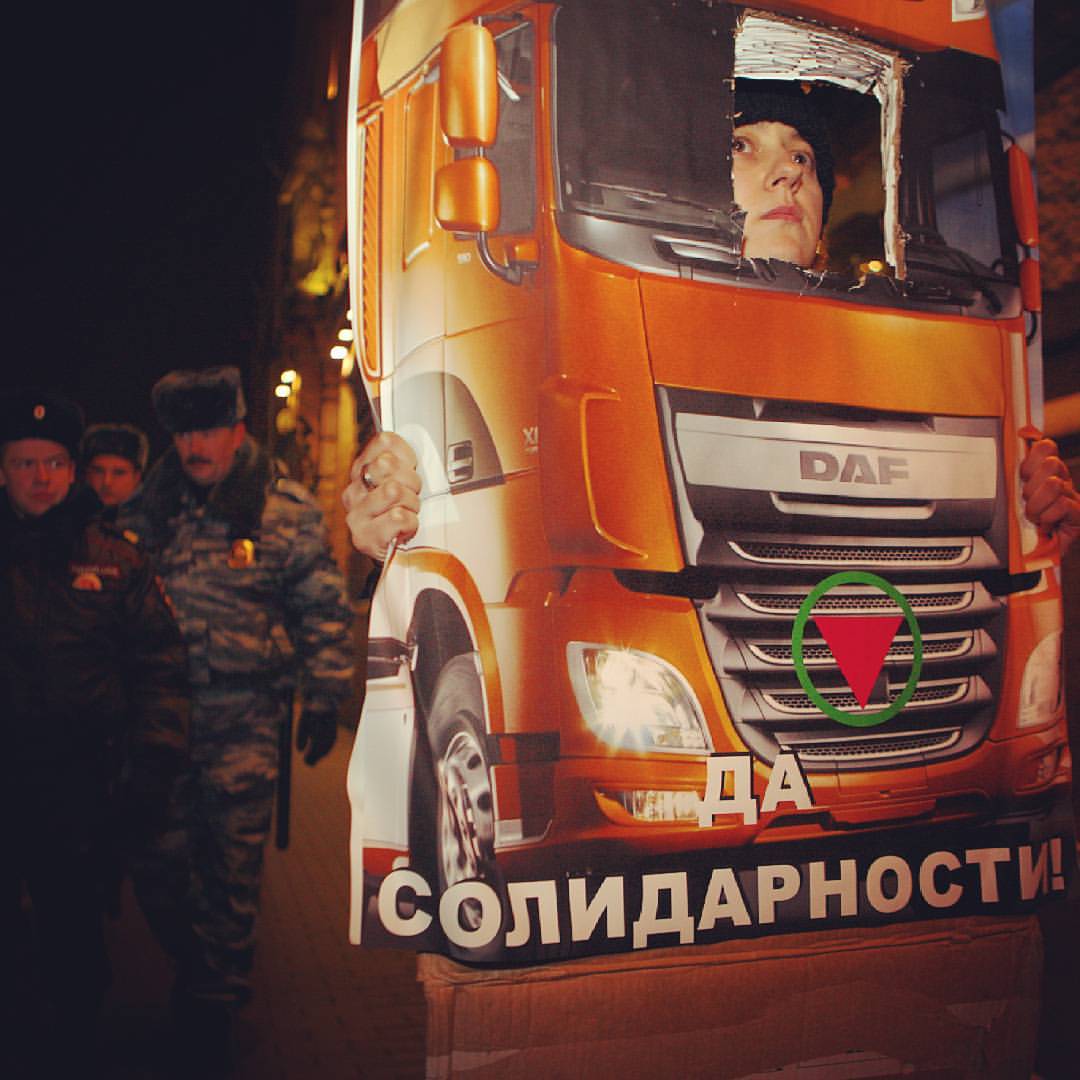
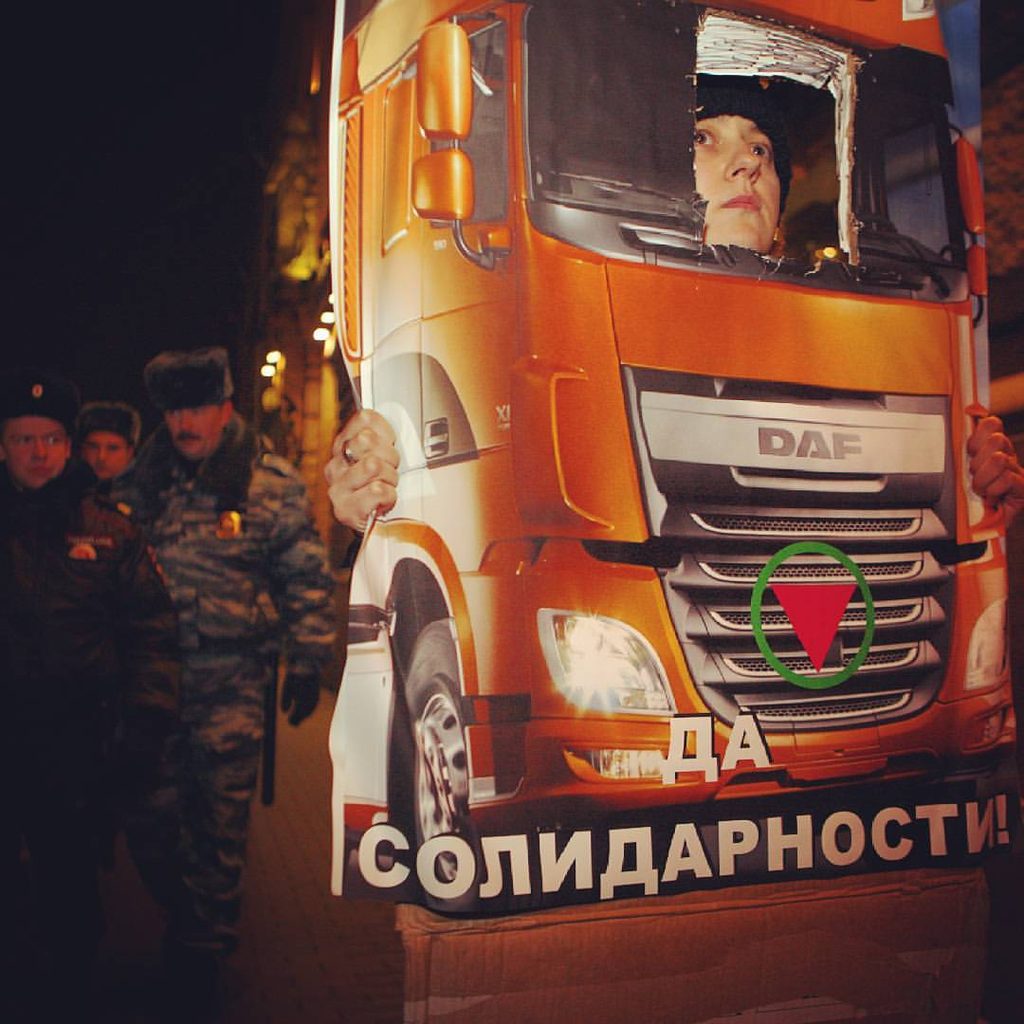
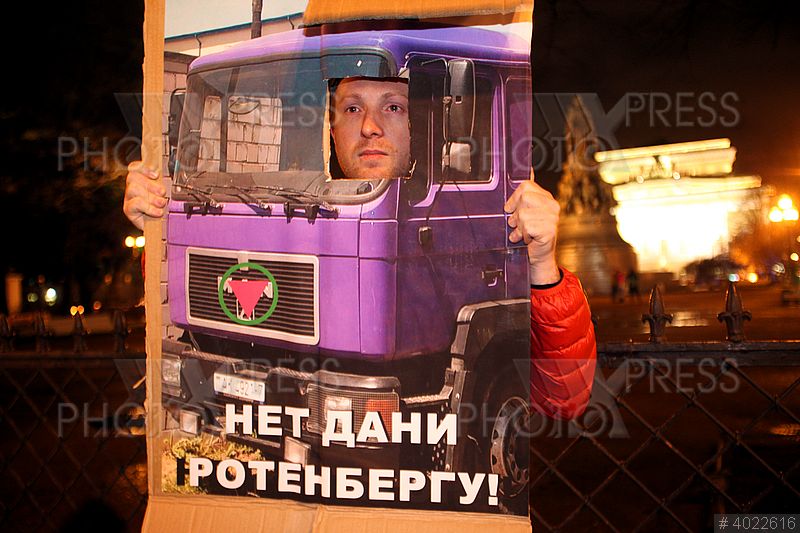
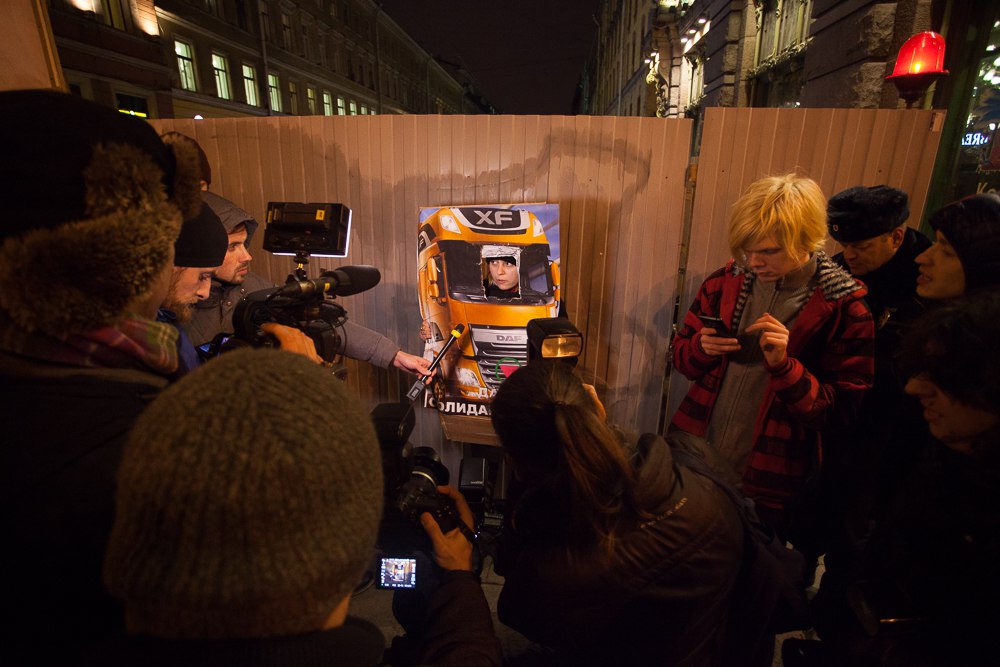
On 7 December 2015, the first solidarity action titled “Today I Am a Truck Driver” took place on Nevsky Prospekt, Saint Petersburg’s central avenue. The format was creative and meticulously planned: activists stood one by one holding specially designed placards shaped like truck cabins. Each “truck” was painted in one of the six colors of the rainbow flag, symbolizing the LGBT community. Holes were cut into the placards so that participants’ faces appeared in the “cab windows,” making it look as if rainbow trucks were literally “driving” along Nevsky Prospekt.
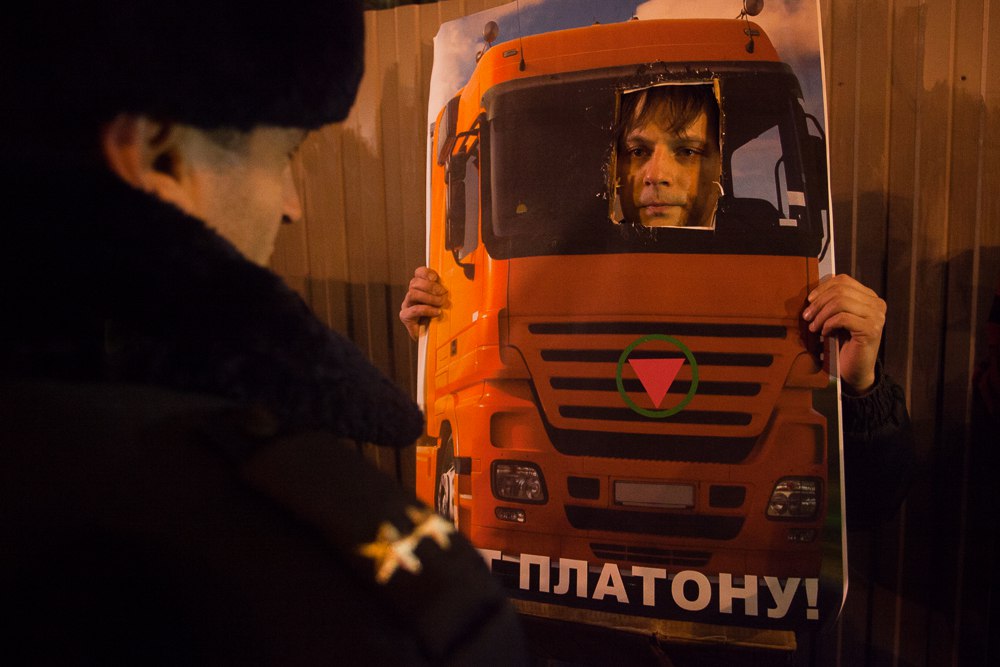
Activists of the Alliance of Heterosexuals and LGBT for Equality during the “Today I Am a Truck Driver” solidarity action on Nevsky Prospekt, Saint Petersburg, 7 December 2015. Here and below in this section.
The press advisory sent to media outlets was deliberately written in an ironic and ambiguous manner to pique journalists’ interest. It announced that “at 7 p.m., six trucks with rainbow-colored cabins would ‘drive out’ onto Nevsky Prospekt.” The effect was immediate: an hour before the action, one reporter called the organizers to ask where the “rainbow trucks loaded with gays” would be coming from.
The placards bore slogans such as “No to Platon!”, “Yes to solidarity!”, “People quieter — prices higher!”, “Citizens are not cattle!”, “No media censorship!”, and “No to the 10.5-billion-ruble tribute to Rotenberg!” Instead of automotive logos, the drawn truck hoods displayed the Alliance’s logo—a pink triangle inside a green circle—emphasizing who had organized this column of “rainbow trucks.”
Formally, the action consisted of a series of single-person pickets, as participants replaced one another sequentially. This legal workaround made it possible to avoid police detentions for violating regulations on unauthorized public assemblies.
Activists also distributed a special leaflet addressed to the public, drawing parallels between the experiences of the LGBT community and the situation of truck drivers. It noted that the state employs similar methods against “inconvenient” groups:
“Media silence, attempts to label groups as a ‘fifth column,’ hate propaganda, legislative pressure, and harassment by law enforcement—these are all things the Russian LGBT community has experienced in full. Today, much of this is being experienced by Russian truck drivers.”
The Alliance urged citizens not to succumb to the authorities’ “divide and rule” tactics, but instead to unite:
“The only way to counter this is through civic solidarity, collective action, and mutual support.”
This message was shared both online and during the action itself, reinforcing the impact of the visual imagery.
The action lasted about an hour and attracted significant public attention. Passersby on Saint Petersburg’s main avenue encountered an unexpected scene: rainbow trucks with young people peering out of their “windows” in support of truck drivers. Unlike many LGBT pickets, which are often met with aggression, this action passed without incidents.
The event attracted media coverage, with more than 30 publications, most of them neutral or positive in tone. Only a few pro-government outlets reacted negatively. One claimed that the U.S. State Department had become disappointed in the opposition and was now funding “rainbow boys and girls” to destroy Russia. In response, activists joked about their “unpaid salaries,” even floating the idea of a mock picket outside the U.S. consulate demanding the promised money—money that, of course, had never existed.
Other journalists noted the unusual alliance: “Active support for disgruntled drivers is being expressed by representatives of the Communist Party and sexual minorities.” Thus, the information space began to acknowledge that LGBT activists had joined the truck drivers’ protest movement.
“We found a creative approach that worked even under restrictive conditions, allowing us to draw attention to the truck drivers’ protests and demonstrate the idea of solidarity. The action showed that what matters is not always the number of participants, but a well-conceived concept built on the contrast between established social stereotypes. Burly truck drivers and bright LGBT activists—many assume these groups have little in common. Our action showed that first and foremost, we are citizens who can stand in solidarity,”
— said action organizer and LGBT activist Aleksei Sergeev.
Support from LGBT activists did not end with the December 2015 action. They launched an online solidarity campaign, publishing updates on the protests, explanations of the Platon system, and calls for civic unity on the Alliance’s social media pages. A downloadable leaflet declared: “The day before yesterday—orphans, yesterday—LGBT people, today—truck drivers, tomorrow—YOU!” The phrase conveyed a key message: state arbitrariness threatens all groups in turn, and any citizen could be the next target.
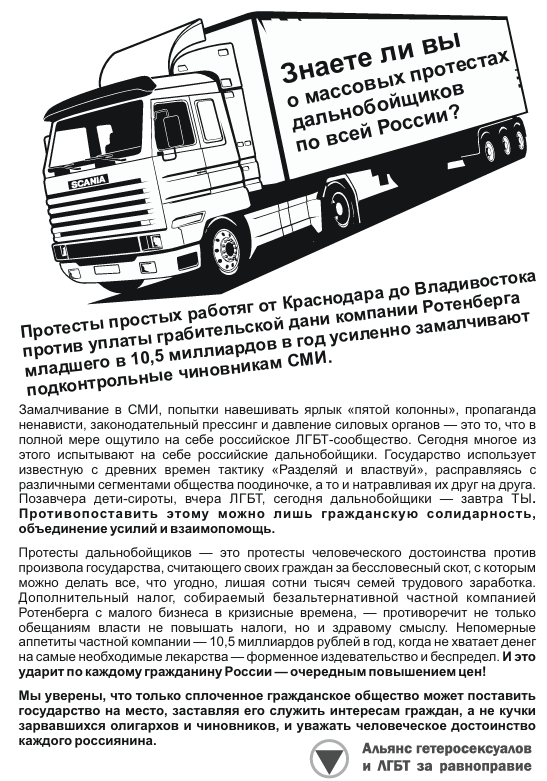
Photo: Leaflet by the Alliance of Heterosexuals and LGBT for Equality in support of the truck drivers’ protests.
Alliance activists also continued participating in broader civic protests. During the winter, they visited the truck drivers’ protest camp outside Saint Petersburg several times, bringing food and supplies, meeting drivers, and distributing leaflets. Personal interaction helped dismantle mutual stereotypes: many activists had assumed truck drivers were uniformly hostile and homophobic, but discovered that many of them, having travelled widely across Russia and Europe, turned out to be considerably more tolerant than the average Russian. In turn, drivers began to see LGBT activists as allies and thanked them for their support.
Facing the drivers’ persistence and increasing media resonance, the authorities made concessions. As early as December 2015, fines for non-payment of Platon were reduced by a factor of 100. Under pressure from mass protests, the launch of the system was postponed and tariff reductions were promised, temporarily calming resistance. These concessions were framed as a “moratorium,” with the expectation that the protests would eventually lose momentum.
Continuation of the Protests and the Campaign
Despite the temporary victory, pressure from the authorities and state propaganda, the truck drivers’ protest movement persisted throughout 2016–2017. In 2016, truck drivers established a public organization, the Association of Russian Carriers (ARC), which was officially registered only in January 2017. As some of the protesters’ demands were met and the intensity of the protests declined, the LGBT activists’ campaign was temporarily put on hold.
In the spring of 2017, amid government plans to double the Platon tariff starting on 15 April, a new wave of strikes erupted. The largest protests took place in Dagestan, where thousands of trucks participated in demonstrations on highways. The authorities responded harshly: National Guard units, special forces, and armored vehicles were deployed to the protest camps, surrounding the truck drivers, while mobile communications were jammed. In Saint Petersburg, instead of dialogue, the authorities resorted to targeted repression against protest leaders: one of the organizers was arrested for 14 days on a fabricated pretext. Peaceful actions were banned, and pro-government media spread false reports alleging that truck drivers had set a vehicle on fire.
Nevertheless, protests across Russia continued and became increasingly political. Many drivers openly expressed distrust in the government and demanded investigations into corruption at the highest levels of power. In the spring of 2017, independent media in Saint Petersburg once again recalled the “Today I Am a Truck Driver” campaign as a symbol of broad civic support for truck drivers. By that time, the story had already secured its place in the chronicle of Saint Petersburg’s creative activism.
Activists decided to revive the campaign. When city authorities banned a planned truck convoy around Saint Petersburg in the spring of 2017, LGBT activists found a creative alternative. They organized a “toy motorcade” on Nevsky Prospekt. In this mini-demonstration, more than 30 toy trucks, pulled on strings, “drove” in a column along the pedestrian zone near Gostiny Dvor. The tiny convoy was even accompanied by a toy police car. As placards were officially banned under the threat of detention, activists placed a volume of works by the ancient Greek philosopher Plato on one of the toy trucks—a transparent reference to the hated toll system’s name. The ironic action attracted the attention of passersby and journalists, giving truck drivers present at the event an additional opportunity to voice their demands to a wider audience through the media.
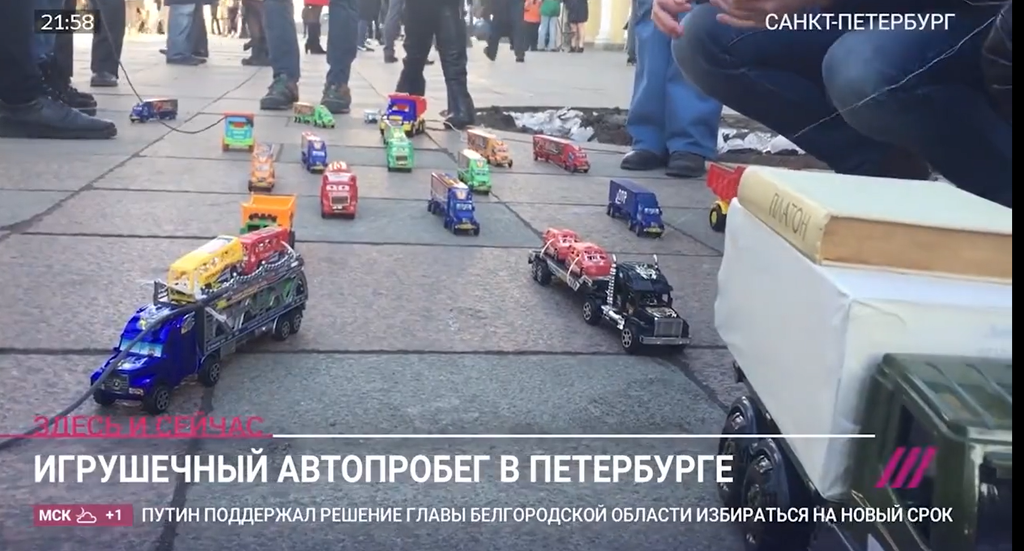
Toy motorcade on Nevsky Prospekt, spring 2017. Still frame from a TV Rain (Dozhd) report
“Some of the toy trucks were purchased at a nearby wholesale toy warehouse, while others were brought from home by participants. I took the volume of Plato from my personal library. The image of a toy convoy in the center of Saint Petersburg attracted as much attention—if not more—than a real motorcade would have, had it been permitted. This once again shows that creative activism saves resources and draws attention,”
— said Aleksei Sergeev.
During a visit by activists to a new protest camp, a 50-year-old truck driver who had not previously met them—unaware that he was speaking to LGBT people—openly told them over tea:
“You guys are young — stand up for LGBT rights… They are normal people, the same citizens as everyone else. The authorities are trying to pit us against each other. It won’t work!”
These words deeply moved and inspired the Alliance participants.
At the beginning of 2017, truck drivers and Alliance activists also demonstrated solidarity during another high-profile protest in Saint Petersburg. Following the governor’s January announcement of his decision to transfer Saint Isaac’s Cathedral to the Russian Orthodox Church, many residents took to the streets. The city’s largest cathedral and a symbol of Saint Petersburg functioned as a profitable museum, funding not only the building’s maintenance and research and restoration work, but also contributing to the city budget. At the same time, religious services were already held there, making the Church’s ambitions clearly financial in nature.
The “For the Museum” movement united a wide range of city residents—from elderly women holding placards to truck drivers and LGBT activists. The Alliance organized satirical “Kneeling Readings” of the Constitution near the cathedral, mocking the violation of Russia’s constitutionally enshrined secular character of the state. Activists knelt and chanted articles of the Constitution in a sing-song manner, imitating church hymns.
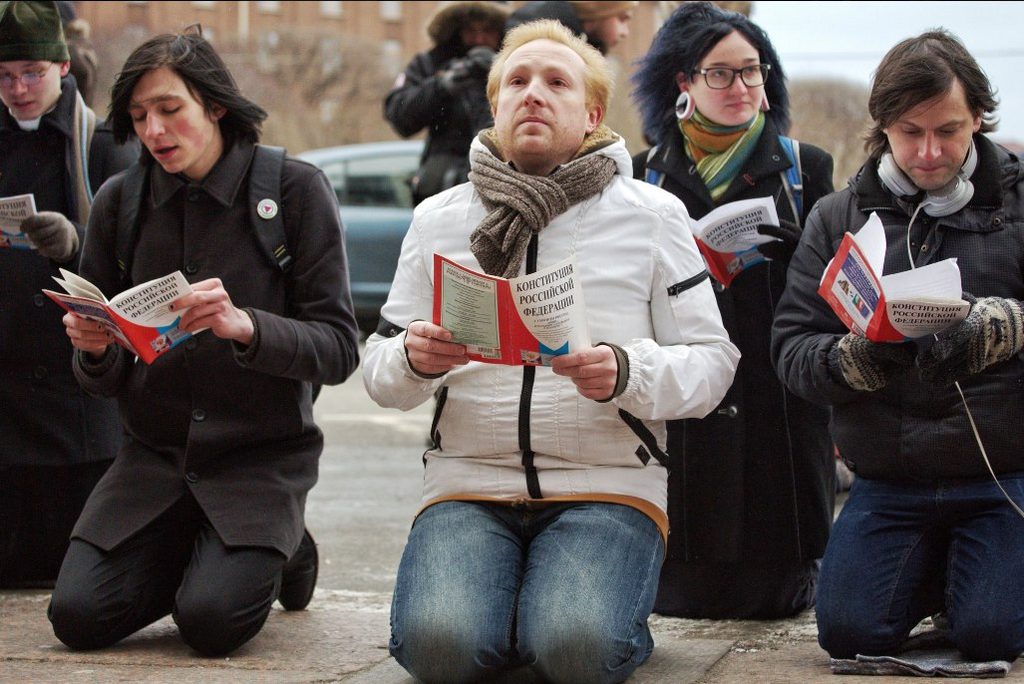
Photo: “Kneeling Readings of the Constitution” near Saint Isaac’s Cathedral.
LGBT activists and truck drivers also took part in a joint performance inside the cathedral, holding printed A4 sheets that together spelled out the slogan “The Museum Belongs to the City!”
When journalists from tabloid media asked one of the truck drivers whether it was “shameful to stand next to gays,” he replied that “If these are the only people in the city with balls, then it’s an honor to stand with them.”
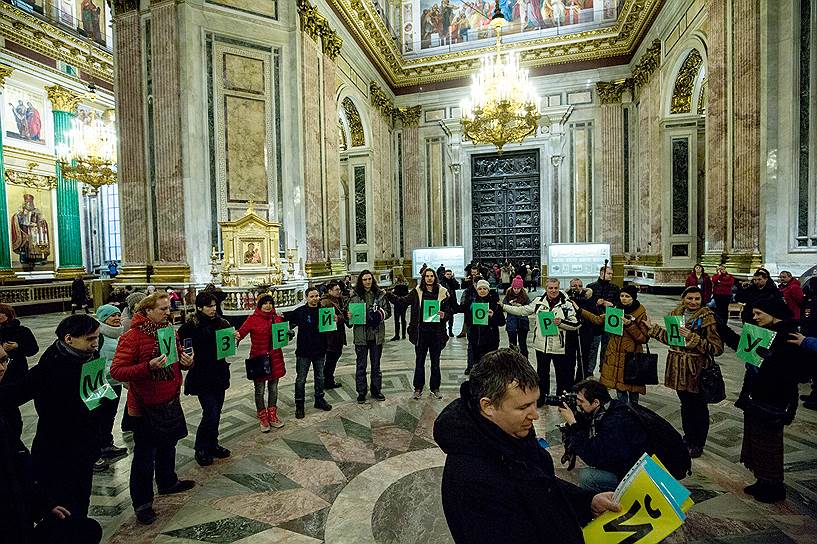
Photo: Action inside Saint Isaac’s Cathedral in support of its museum status.
However, this peaceful action provoked outrage among conservative authorities. From the parliamentary rostrum, Speaker of the Saint Petersburg Legislative Assembly Vyacheslav Makarov declared that such a “blasphemous raid inside a church had offended the feelings of hundreds of millions of Orthodox believers.” The majority of deputies appealed to the Investigative Committee, demanding criminal charges against the activists for offending religious feelings and calling for their imprisonment. Alliance members were among the protesters, and both they and their allies experienced significant anxiety.
In response, activists devised a satirical counter-action titled “Offended Russia.” They adopted the personas of ultra-religious “patriots” of a fictitious movement and staged a humorous performance outside the Mariinsky Palace, fully “supporting” the authorities’ initiative. Dressed as “the offended,” they called for banning all civic actions (except religious processions and military parades) and for punishing “blasphemers” as harshly as possible. They even proposed renaming the Legislative Assembly the “Committee of State Spirituality” and introducing the form of address “Father Deputy.” The action received positive media coverage, generated jokes and memes, and drew public attention to the situation.
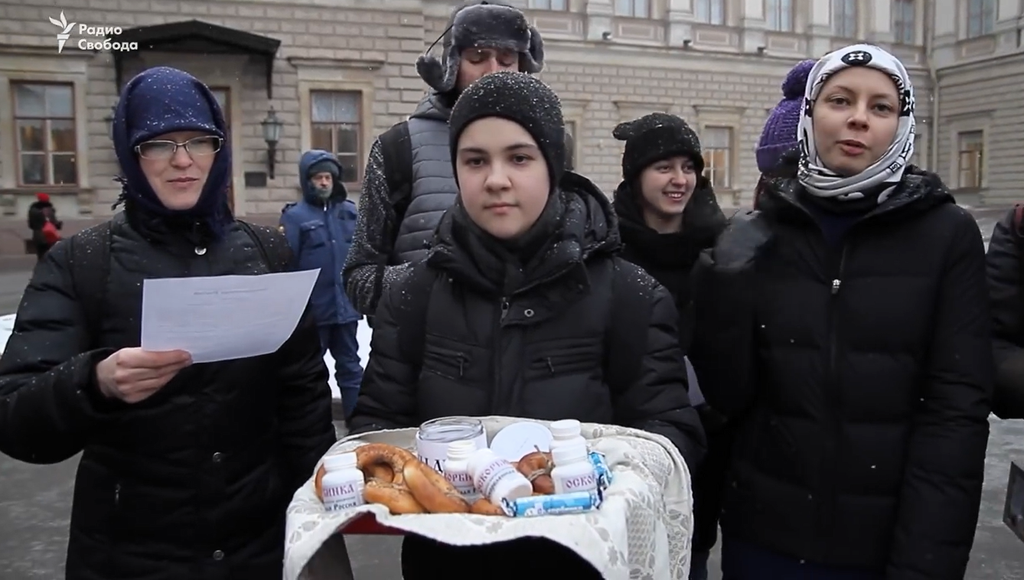
Photo: Action by LGBT activists posing as the fake movement “Offended Russia” outside the city parliament.
Through this grotesque performance, activists highlighted the absurdity of a secular authority behaving like a “holy inquisition,” demonstrating that laughter and exaggeration can be effective tools against fear and obscurantism. Fortunately, a few days later, Russia’s Investigative Committee refused to open a criminal case over the cathedral incident, finding no elements of a crime under the article on “offending religious feelings,” which had been introduced into the Criminal Code following the Pussy Riot punk prayer in a Moscow church.
Through the creative campaign and personal interactions in protest camps and at demonstrations, cooperation between Saint Petersburg truck drivers and LGBT activists gradually evolved into mutual support. This story of solidarity concluded with a symbolic event: a group of truck drivers arrived with ARC flags at the Saint Petersburg LGBT Pride on Mars Field in the summer of 2017 to openly support the queer community and assist organizers with event security. For the first time, representatives of the truck drivers’ protest movement publicly acted as allies of LGBT people at a Pride event—an illustrative outcome of the bold idea conceived two years earlier.
Solidarity Under Pressure: Conclusions
The case of LGBT activists supporting protesting truck drivers initially seemed exotic to many. Even within the LGBT community, truck drivers were often perceived as predominantly conservative and distant from the agenda of sexual minority rights. During the campaign, activists realized that they themselves had been trapped by a “false consensus,” and that reality exceeded their expectations. Under authoritarian conditions, such cross-group solidarity takes on particular importance.
Russian authorities have traditionally sought to isolate and suppress different protest-capable groups one by one. Today it is drivers; tomorrow, urban activists; the day after, environmentalists or any other inconvenient force. Alliance activists explicitly pointed this out:
“The state uses the age-old tactic of ‘divide and rule,’ repressing different segments of society individually or even pitting them against one another. The day before yesterday—orphaned children, yesterday—LGBT people, today—truck drivers; tomorrow—YOU.”
The only way to counter this tactic is through collective action.
In this story, both communities benefited. For truck drivers, support from an unexpected creative ally helped amplify the protest’s media dimension, communicate messages to society, and circumvent bans on public actions—conditions that LGBT activists in Russia had long learned to navigate.
For LGBT activists, participation in supporting the truck drivers also had advantages. It expanded the coalition supporting their own movement. Many liberal-minded citizens may have seen LGBT activists for the first time not through the lens of state propaganda, but as equal participants in civic protest. The fact that LGBT people cared about “others’ problems” challenged the stereotype of an insular LGBT community.
It also became clear to many that LGBT people and truck drivers share common interests as citizens—for example, resisting corrupt payments to oligarchs and demanding justice. LGBT activists stated openly:
“Whether you are heterosexual or LGBT, first and foremost you are a citizen who will bear the burden of this additional tax.”
This message helped draw public attention to the fact that the Platon problem affected everyone, regardless of sexual orientation or social group.
The campaign also provided activists with valuable experience, demonstrating that creative public action can resonate with diverse audiences. The “Today I Am a Truck Driver” action was positively received even by some opponents; social media comments included remarks such as “Didn’t expect this from them—well done for supporting working people.” Of course, there was also mockery from homophobic circles, including sarcastic references to “gay truck drivers” by pro-Kremlin bloggers, but ultimately this only increased awareness of the protests.
The campaign not only drew public attention to the issue but also demonstrated that the principle of solidarity remains alive in Russian society, and that the real confrontation is not between different social groups, but between society as a whole and a repressive state system.
In the long term, such examples of cross-movement support can play an important role. Historical experience, including the alliance between British LGBT activists and miners, shows that when marginalized groups stand together, the public discourse itself begins to change.
In Russia in 2015–2017, this was especially relevant: the regime did everything it could to fragment protest movements and portray them as marginal. Yet the “rainbow trucks” on Nevsky Prospekt became a vivid illustration of the opposite—that very different people can unite in mutual support. Under authoritarianism, solidarity is essential for the survival of civil society.
The “Today I Am a Truck Driver” campaign became one of the most striking examples of mutual support between social movements in contemporary Russia. LGBT activists in Saint Petersburg demonstrated that, in the struggle for civil rights, there are no “other people’s problems.” Their rainbow-colored truck-cabin placards supporting truck drivers were not only a bold gesture but also a strategically calculated response to policies aimed at dividing society. This case illustrates how creative solidarity can strengthen the resilience of protest movements even under authoritarian conditions and serves as an inspiring example for activists worldwide.